
The Night Sky, 2nd To 8th April 2022
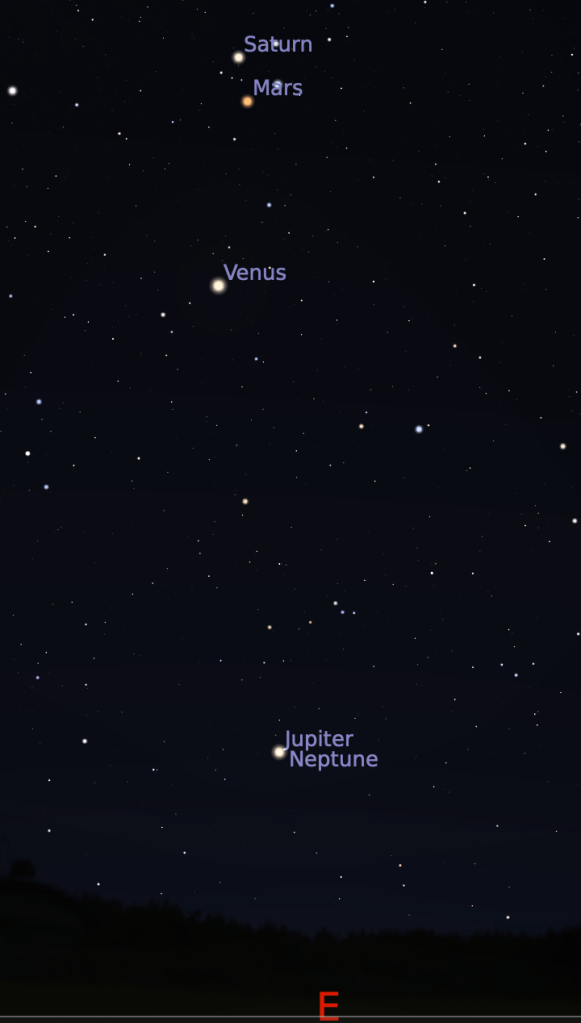
The eastern pre-dawn sky is still the place where it is all happening. Head out by 5am and imagine an arc across the sky from West to East, effectively the Ecliptic; this defines where roughly the planets appear to travel, screenshot below. Now on the eastern side of that arc look for a golden non-twinkling object sitting 40 degrees above due East, you have found Saturn.
Now, a mere 5 degrees further down the arc to the East is the rusty future colony of Mars sitting 35 degrees up. From here, keep scanning down the arc to find the unmistakable brilliance of Venus (25 degrees up).
Now, next stop is my favourite orb, Jupiter, lolloping 10 degrees above due East. While Jupiter has been surpassed by Saturn for the most number of moons, it still has the honour of being the largest planet in our Solar System with the largest moon, Ganymede; it is also possible in binoculars to see its 4 largest moons. As an added bonus, while low to the horizon by 5:30am, try looking to the SW of Jupiter on Wednesday to see whether you can find the faint blue Neptune less than 0.1 degrees away; it appears blue due to the absorption of red and infrared light by its methane (phew) atmosphere, see screenshot below.
While sunrise is still an hour off, take the time to look at them all and consider a photo of the apparent string of planets; while smartphone cameras differ, try 1 to 10 second exposure, an ISO/ASA 800, focus at infinity, better still try a real camera.
 Astronomy West
Leave a comment