Christmas is almost upon us and in the week leading up to it, early morning risers are limited to the almost Christmas like star, but a planet, Venus which can be found sitting 20 degrees above the eastern horizon 30 minutes before sunrise, say around 4:30am, after it rose just before 3am. While not easy, but worth timing getting ready with the binoculars, on Saturday and Sunday, Venus is 2 degrees from the star alpha Libra (Zubenelgenubi), alpha normally meaning brightest, but in this case it is the second brightest star in Libra with beta Libra (Zubeneschmali) the brighter; pull out the binoculars and look for yourself. In olden times, brightness’s were determined by comparison to other stars, which may themselves have changed.
While on the topic, there’s a whole industry on observing stars whose brightness changes, Variable Stars, it’s a great pastime if you suffer from insomnia or are retired and need to occupy yourself. Head to the International website ( https://www.aavso.org ), join up and find others in Western Australian and Australia that keep this old, but still very important, field of amateur astronomy alive, it’s even good for the kids and grandkids and what’s more its free and an enjoyable STEM activity., akin to getting them to eat their green’s.
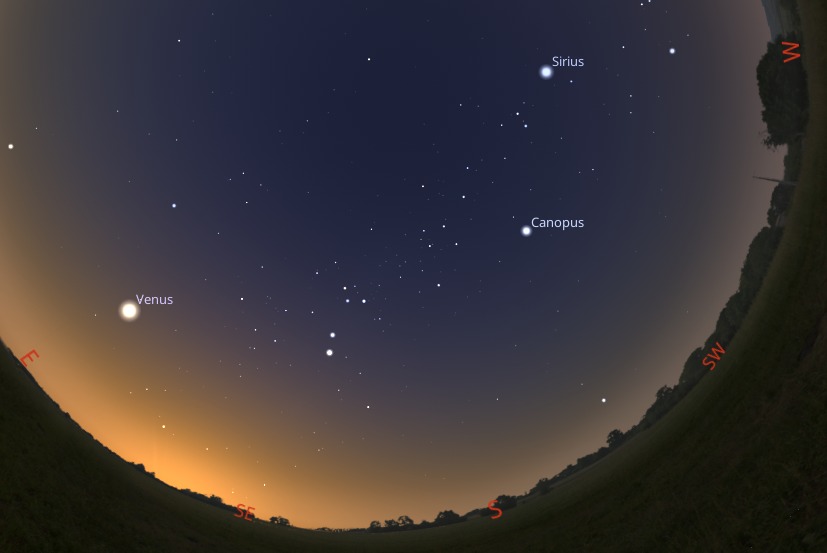
And I’ve done a screenshot of East to West including Venus to also suggest after espying Venus, just wander through the disappearing dark night sky to the West.
Evening viewers are more fortunate with viewing opportunities.
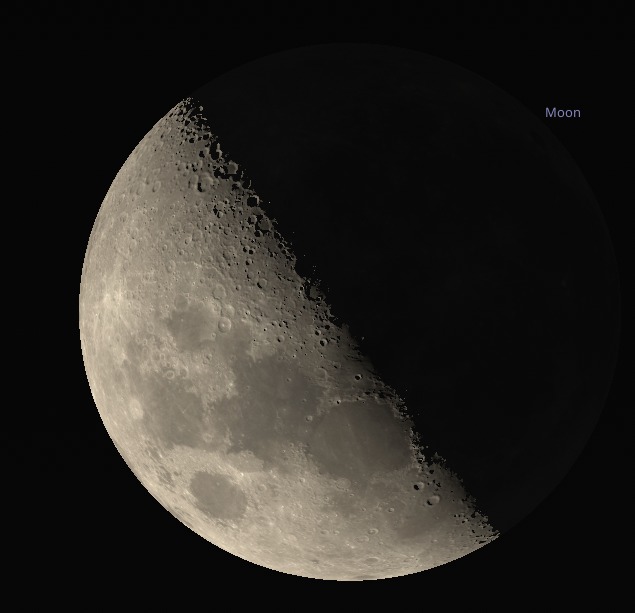
The Moon is at first quarter on Wednesday at 2.39am, or course, to us it won’t be visible at that time, but if you had been up at 11:30pm on Tuesday, it would have looked a little like in this screenshot, just look at those craters, seas and riles, in binoculars they are just mesmerising.
The planet Saturn is boxed by the Moon Sunday and Monday presenting a great photographic opportunity (maybe suggest it to your local photographic club) and sits 40 degrees up, midway between West and WNW by 8pm; it sets in the WSW to West by 11pm.
By Friday, the Moon and Jupiter will also Tango (of Argentina and Uruguay origin) with each other 45 degrees up and slightly East of due North at 8:30pm; Jupiter sets by 2am in the West to WNW.
Now, mimicking a slow daylight-saving event, we had 10 hours of daylight in June, the Solstice occurs on Friday when we have over 14 hours, and we don’t complain? The term Solstice is from the Latin ‘solstitium’ or ‘Sun stands still’, which of course it doesn’t, it just appears that way to us on Earth; it’s a great day to just visit your nearest beach and watch the Sun set and the gardens of the night sky open up.
And as I keep banging on about, while Meteorological calendars defined December 1st as the beginning, astronomically and physically, Friday is the actual start of Summer, you cannot change the tilt of the Earth nor its orbit around the Sun, but with “Global Warming” and a “Changing Climate”, have we in another way?
Dr Craig Bowers MP8138.
All screenshots are courtesy of Stellarium planetarium
Zotti, G., Hoffmann, S. M., Wolf, A., Chéreau, F., & Chéreau, G. (2021). The Simulated Sky: Stellarium for Cultural Astronomy Research. Journal of Skyscape Archaeology, 6(2), 221–258. https://doi.org/10.1558/jsa.17822


 Astronomy West
Leave a comment