
First of all, just step outside and spend a few minutes looking at the night sky North and South, its awesome and hangs there same way that bricks don’t 🙂
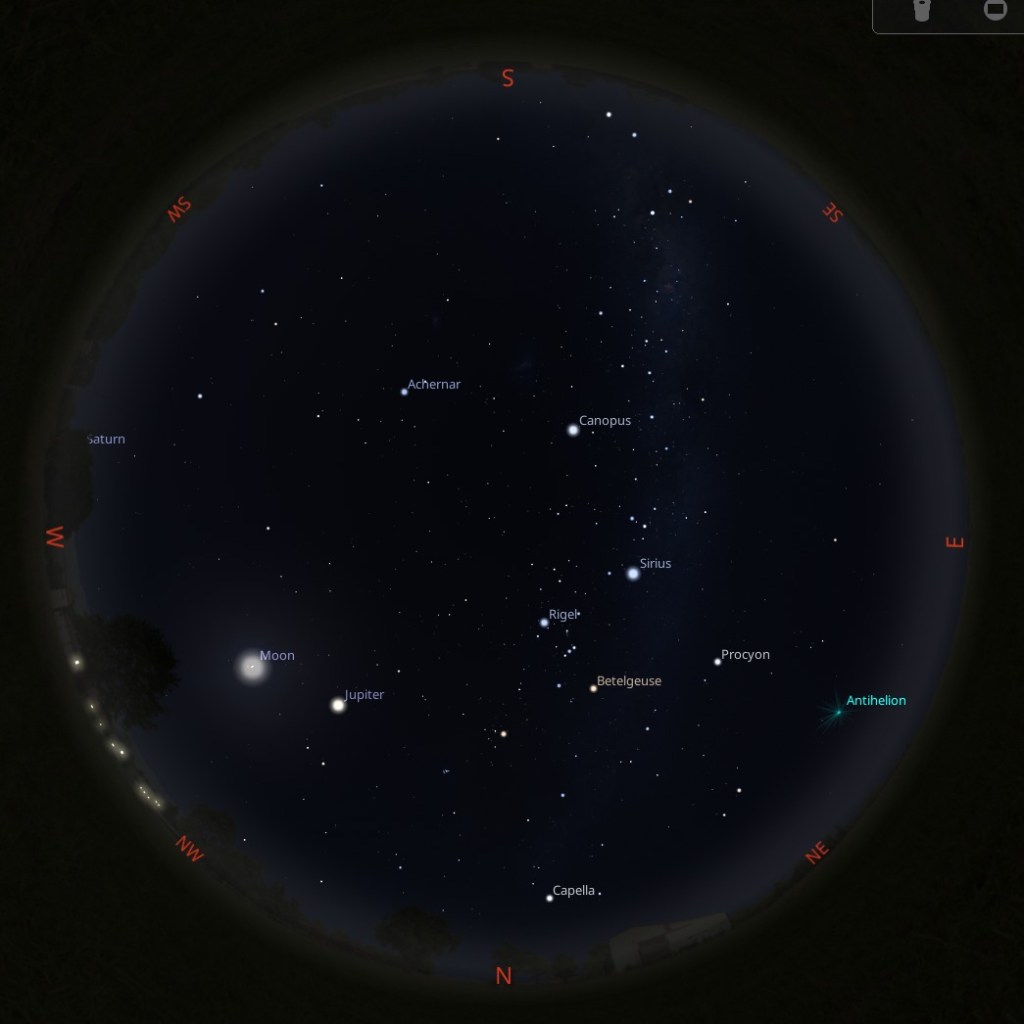
The planet Saturn, as has been the case for a while a bit boring to the naked eye and binoculars as is barely visible, apart from its distinguishing golden hue and even then, mostly outside the City light pollution (Thanks Basil), 30 min after sunset in the West 20 deg. up, it sets an hour later.

But fear not, Jupiter is easily espied 40 deg. above the NNW horizon, setting in the WNW just post-midnight. While sounding like a broken record, seek out its 4 brightest moons and over the week try working out how home they take to move from on side of the planet to the other over a night and days….it’s a great geometry challenge for all.

The morning is still defined by the bedazzling beacon of the planet Venus, resplendent 10 deg. above the ESE horizon at 4am.
Wait an hour after having viewed Venus for Mercury 15 deg. above the same location as Venus in the red glow of the approaching sunrise; Mercury is at its greatest elongation West (23.5 deg.) which means it is at its greatest separation in the sky from the Sun and optimum for viewing. Mercury passes several star clusters this week, watch Tuesday, Wednesday and Thursday in binoculars for what looks like very faint smudges….again, better done at a dark location.
As per last week, caution should be taken to try and spot Mars in binoculars 10 deg. above the ESE at 5am as our last viewing….then if you have the day off or have finished your night shift, sit down and watch “The Martian”.
For general stargazing starting at 10pm, even with a waxing Moon, the constellation Orion, the Hunter sits 60 deg. above due North. Find the middle of the three stars in his belt, go up 5 degrees to find the misty glow in the middle of three stars in his sword called the Great Orion Nebula (M42). When you next visit an observatory or go on a viewing night with access to a telescope, ask to see the Trapezium, which is effectively 4 stars buried in M42 which binoculars cannot split.

This week 8 years ago saw the first ever flower grown in space, on the ISS of course, for the Botanists …..it was a zinnia (image courtesy NASA/Scott Kelly

Dr Craig Bowers MP8138.
All night sky screenshots are courtesy of Stellarium planetarium
Zotti, G., Hoffmann, S. M., Wolf, A., Chéreau, F., & Chéreau, G. (2021). The Simulated Sky: Stellarium for Cultural Astronomy Research. Journal of Skyscape Archaeology, 6(2), 221–258. https://doi.org/10.1558/jsa.17822
 Astronomy West
Leave a comment