Jupiter is still the most prominent celestial object dominating the NNW horizon by 8pm when it can be found sitting 40 degrees up. …..that’s four stacked clenched fists at arm’s length, each being 10 degrees.
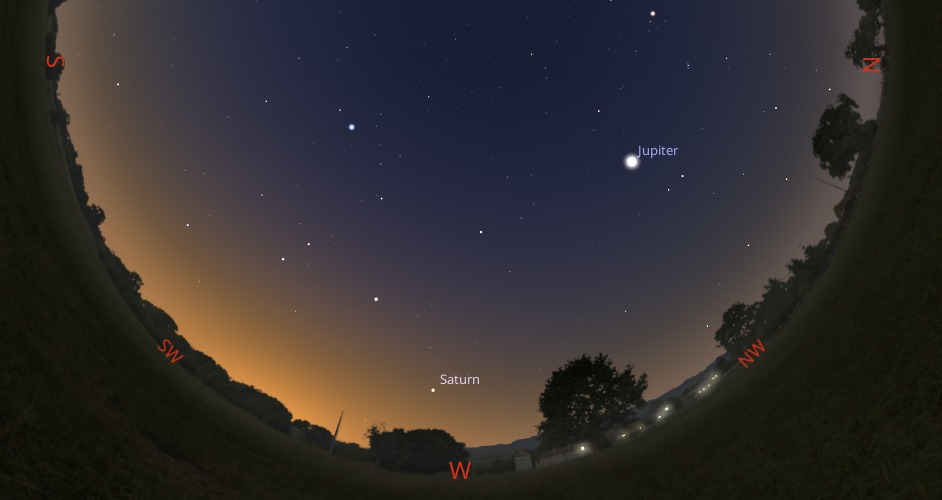
I’d wait an hour when it sits 30 degrees above the NW. At this point, its 4 brightest moons, surprisingly discovered by Galileo 414 years this month are clearly visible in binoculars; it sets by midnight.
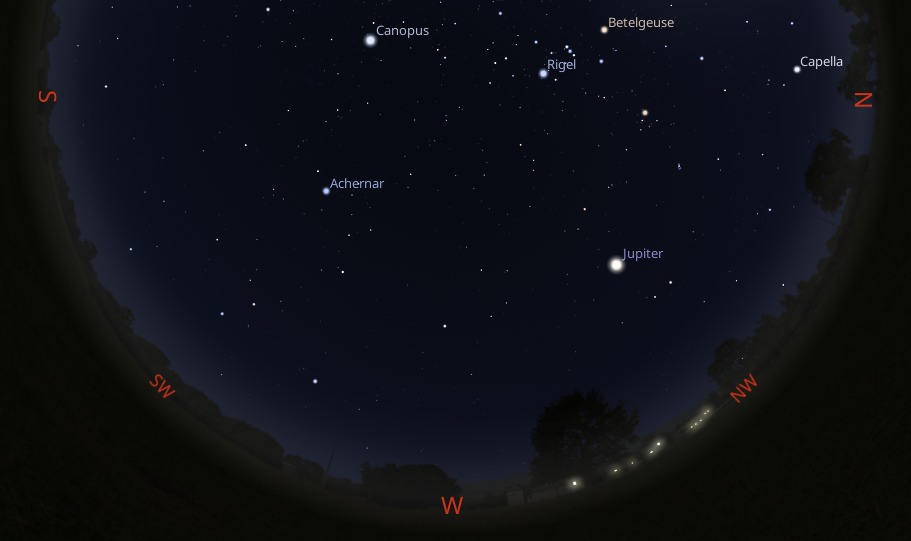
Saturn is disappearing into the setting Suns glow in the West around 8pm and is a challenge to spot even in binoculars 15 degrees up, although the other night it stood out to me at the end of my driveway? maybe good atmospheric conditions, who knows, but the golden hue set it apart from the stars visible at that time.
Now, imagine a line from Saturn to Jupiter and extend that to 10 degrees above the North to NNE to find the bright star Capela. A northern hemisphere star in the constellation of Auriga (The Little Goat) who in classical mythology suckled the young God Zeus or in Hindu the heart of Brahma, in fact there is a veritable list of its mythological origins in differing cultures as is the case for many constellations.
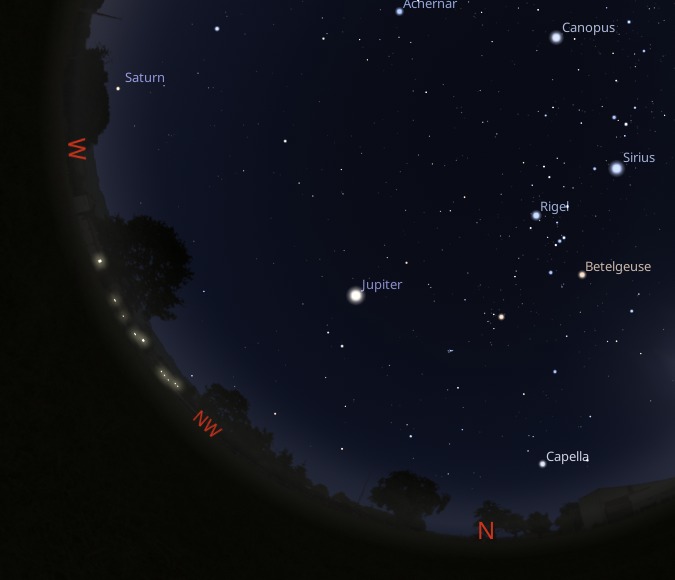
Post-midnight, say around 2am, find the unmistakable setting constellation of Orion (The Hunter) in the WNW (it’s kind of on its side and he’s standing on his head) and slowly scan the Milky Way with binoculars past the brightest star in the night sky, Sirius sitting 45 degrees above the West to WNW, and onwards towards the Southern Cross sitting 50 degrees above the SE to SSE, stopping whenever something peaks your interest; I like to meander my way through and try and find stars that are not white as well looking for the telltale smudges that could be nebulas, or just grease from the lens when I touched it after scoffing a bacon sarnie 🙂


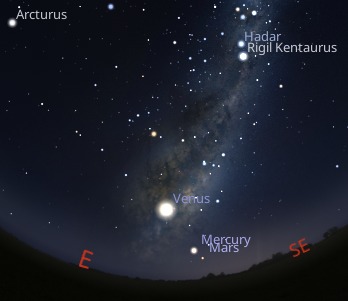
By 4am, Venus breaches the ESE vista…..it’s kind of inspiring if you have an uninterrupted view of the horizon and I find a great start to the day. Venus is followed by Mercury by 4.15am and if you again have that uninterrupted horizon, Mars can possibly be glimpsed sitting 10 degrees up leading up to 5am, but only by the end of the week.
The Moon is full on Friday at 1.54am so the sky is washed out like in the City, only that’s all the power being wasted over night when nobody is in the office.
Dr Craig Bowers MP8138.
All night sky screenshots are courtesy of Stellarium planetarium
Zotti, G., Hoffmann, S. M., Wolf, A., Chéreau, F., & Chéreau, G. (2021). The Simulated Sky: Stellarium for Cultural Astronomy Research. Journal of Skyscape Archaeology, 6(2), 221–258. https://doi.org/10.1558/jsa.17822
 Astronomy West
Leave a comment