
Well, March already and some would say that Summer is over, well, that’s not exactly true. Meteorologists and climatologists like to fit our 4 ‘seasons’ into neat little 3-month boxes, Winter, Spring, Summer and Autumn. The ‘seasons’ are actually as a result of the Earth’s tilt towards the Sun, so different parts of the Earth receive different amounts of the Sun’s rays as the Earth orbits around the Sun. So, the equinoxes and solstices ie astronomical events, are actually the turning points for the seasons, not the beginning of the month. So, in this instance, astronomically, we are still 3 weeks away from summer ending and autumn starting, which will occur on Wednesday 20th when we have the Autumnal Equinox. In support of this, on this day the Sun will rise due East (90 deg. azimuth) and set due West (270 deg. azimuth). As a comparison, on March 1, the Sun rose with an azimuth of 99 deg. and set with an azimuth of 261 deg.
Consider this, however many years the ‘Australian’ indigenous population have been around, their calendar had/has 6 seasons for a reason? more than likely because it worked. Being all knowledgeable, the colonists brought a square peg British calendar and hammered it into an Australian round hole, because ‘we’ve always done it this way’. Anyway, with Climate Change and a Changing Climate, I’m not sure even the 6 seasons work anymore.
Now, off your speaker’s box Craig……depending on the source, there are anywhere from 30,000 to 40,000 manmade objects greater than 10cm circling the Earth since Sputnik almost 70 years ago. Apart from these objects there are around 500,000 between 1cm and 10cm and it is thought possibly 100 Million plus exceeding 1mm, some as a result of ‘accidents’ or just bad management and inaccurate databases. One has to consider that a single piece moving at 10kms per second ! that’s right 10 times the speed of a bullet. While most to the junk is disused components of launches and dead or alive satellites, but what about the Astronaut Ed Whites spare glove misplaced 1965 or a spatula lost by Piers Sellers in 2005 or the camera that drifted away from Sunita Williams during her 2007 spacewalk and don’t get me started on the Moon and whether we will find the small ceramic wafer containing Andy Warhols picture?
On to star gazing.
It is scant planetary pickings at the moment. Evening viewers can espy Jupiter just after sunset sitting 25 deg. above the NW to WNW horizon and before it sets by 9.30pm.


Now face North and let your eyes scan up and south-eastwards to find Orion whose three belt stars then point you to the brightest star of the night sky, Sirius; the name originates from the Greek word ‘Seirios’.

By midnight, Orion sits just above the western horizon and from here one can scan the Milky Way arcing up to 60 deg. and down to the SE, what a corker and maybe a chance to test your photography skills capturing this iconic panorama.

Morning viewers are presented with a duopoly with the brilliant Venus, and possibly mankind’s Issac Asimov’s Spacer planet, Mars, hovering 10 deg. above the East to ESE vista by 5am.
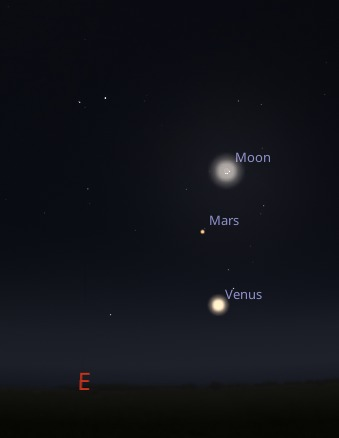
On Friday, the Moon, Mars and Venus present a great photo while one imagines the Moon has a new visitor in the 1908kg (on Earth) lander Odysseus which even with six legs fell on its side (which for many of us is a daily occurrence, even without alcohol  ) remembering that anything on the Moon weighs 1/6th of what it it does on Earth.
Dr Craig Bowers MP8138.
All night sky screenshots are courtesy of Stellarium planetarium
Zotti, G., Hoffmann, S. M., Wolf, A., Chéreau, F., & Chéreau, G. (2021). The Simulated Sky: Stellarium for Cultural Astronomy Research. Journal of Skyscape Archaeology, 6(2), 221–258. https://doi.org/10.1558/jsa.17822
 Astronomy West
Leave a comment