
On Wednesday the Earth will reach the Autumnal Equinox, from the Latin aequus (equal) and nox (night). On, and either side for a few days, there will be almost equal amounts of daylight and night-time hours and no, eggs cannot be stood upright on this day, but scientific Autumn, if there is such a thing, starts on this day. Different religions and faiths use this day to celebrate in different ways, in western Christendom it used to define the date of Easter.
Sorry, I still associate these equinoxes and solstices with the traditional northern hemisphere origins and feel the desires to don a robe, chant like in Monty Pythons Holy Grail and eat lavishly, but that’s me, or maybe you feel the same.
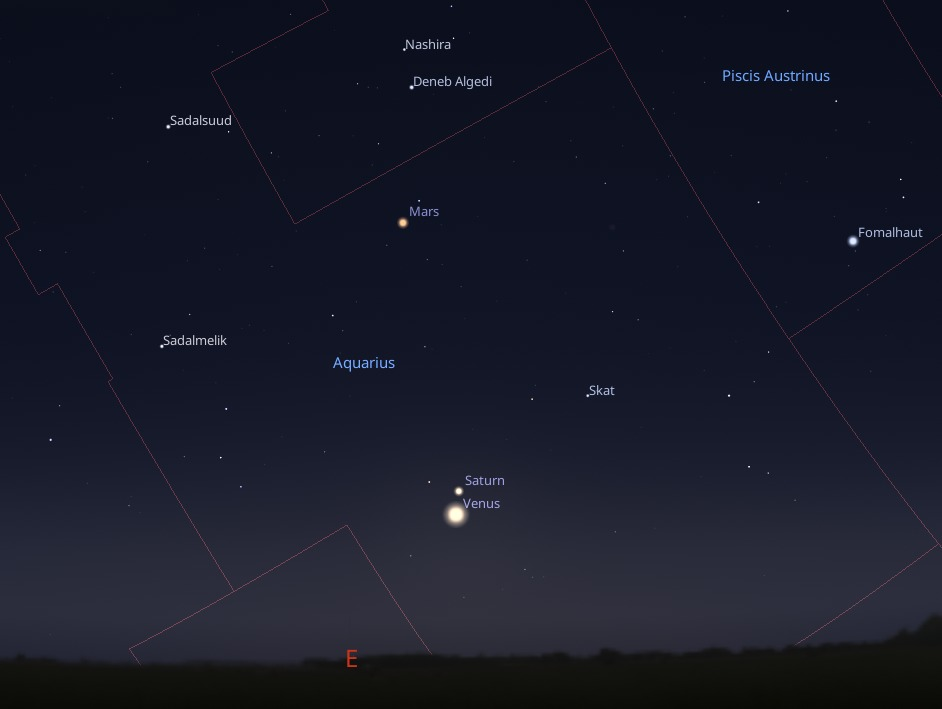
Start this week’s stargazing between 5.30am and 6am by looking to the East to see Saturn sitting at 5 deg. up, before its rises rising to 10 deg. by Sunday. However, on Friday, armed with binoculars will enhance the view of Saturn and Venus appearing to almost touch each other.


Continuing looking up from Venus and Saturn, the planet Mars sits 10 deg. above this pair and lends one to dabble with photography to get a rewarding picture to show your friends.
The western evening sky is still only presenting Jupiter sitting 20 deg. above midway between WNW and NW, setting by 8.30pm in the WNW. However, it should not stop the use of 7×50 or 10×50 binoculars to view its 4 brightest moons, Io, Europa, Ganymede and Callisto, all named after the lovers of Zeus in Greek mythology.

Now, on Monday by 5.40am, look low in the NW and try to picture the brightness of the International Space Station (ISS) heading up to 83 deg. above the SW before dropping down to the SE over 6 minutes.
On Saturday, look low in the WNW by 7:50pm to see if you can see China’s space station, Tiangong, suddenly appearing as a bright star moving upwards to 60 deg. above the SSW before disappearing after 3 minutes.
How did its brightness compare to the ISS?
Tiangong only has 3 modules, the ISS 16 and as its name states, it’s International.
Dr Craig Bowers MP8138.
All night sky screenshots are courtesy of Stellarium planetarium
Zotti, G., Hoffmann, S. M., Wolf, A., Chéreau, F., & Chéreau, G. (2021). The Simulated Sky: Stellarium for Cultural Astronomy Research. Journal of Skyscape Archaeology, 6(2), 221–258. https://doi.org/10.1558/jsa.17822
 Astronomy West
Leave a comment