
The mornings are a veritable planetary feast, maybe head out with breakfast and cuppa to herald in the Dawn or …….
Drag the kids or grandchildren out of bed at 5.45am and look slightly north of due east and just under 10 deg. to find the planet Mercury, which in binoculars, will look like a 25% illuminated Moon; all planets inside the orbit of Earth exhibit phases.
Now, scan up to just over 25 deg. to espy the ruddy red planet Mars; while I’m 65 on Earth I could be 35 on Mars and weigh 2/5ths my current weight; eat your heart out weight watchers.
Finally, the slightly uninspiring ringed planet Saturn sits 40 deg. up and just remember you are looking into the past, light takes 85 minutes to reach us.
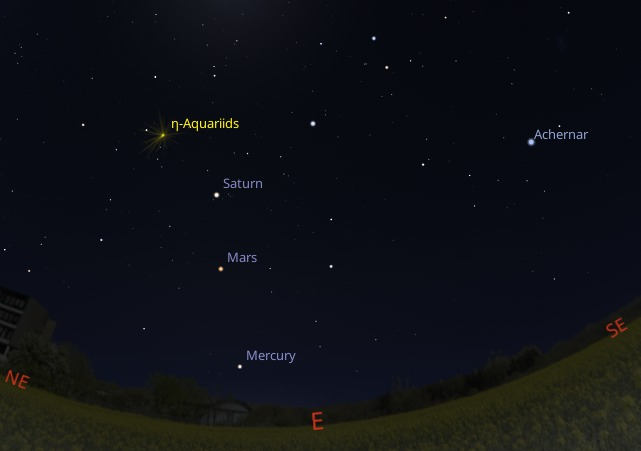
If you have an elevated and clear eastern view, the last vestige of Venus can possibly be made before it heads off into superior conjunction; its hugging the East to ENE vista by 6.15am and it will reappear in mid-July in the western evening skies.

Following on last week’s zodiacal constellation identification by 7pm, Cancer’s Crab actually looks like a crab (from above) with 6 stars, two either side and 2 for the body, but you will need to be away from City light pollution as they are just under naked eye brightness. Look 10 deg. east of due north and 35 deg. up for the middle of the two shell (carapace) stars and then 5 deg. above and below for stars that map out the legs and claws.

Dr Craig Bowers MP8138
All night sky screenshots are courtesy of Stellarium planetarium
Zotti, G., Hoffmann, S. M., Wolf, A., Chéreau, F., & Chéreau, G. (2021). The Simulated Sky: Stellarium for Cultural Astronomy Research. Journal of Skyscape Archaeology, 6(2), 221–258. https://doi.org/10.1558/jsa.17822
 Astronomy West
Leave a comment