
We’ve discussed the origin of our Solar System planetary ring formation, but what about its moon’s?
Outside the general theory of formation from gas and dust circling around planets in the early solar system, some moons are unusual; see how I use the term ‘moon’ with a small ‘m’, but a capital “M” for our Moon, that’s got nothing to do with grammar, the International Astronomcal Union (IAU) is the governing body for object naming and they define our Monn like thus. Anyway, I digress, a recent refereed paper on Neptunes largest moon Triton, which orbits in the opposite direction to the planet and the only one in our solar system to do so, suggests it could have come from the Kuiper Belt.; I’ve mentioned this before, NASA defining it as “…is a doughnut-shaped region of icy bodies extending far beyond the orbit of Neptune. It is home to Pluto and Arrokoth…” While moon’s coming from this region is not unusual, as comets and asteroids mostly come from this region, Tritons composition is very similar to Plutos and so they both could have come from there; so, one moon captured, as opposed to part of solar formation, and an ex-planet, both again challenges our theories of how our Solar System formed.
By now I’m sure your thinking Arrokoth? what the hell is Arrokoth? a character in Lord of the Rings, Vikings, Game of Thrones? It is the name of the farthest flyby ever encounter with an object conducted by spacecraft (NASA’s New Horizons mission), to me it looks like a capless giant stay puft marshmallow man from Ghost Busters.
For early risers, head out by 5am to find Jupiter 15 deg. above roughly the NE vista.

Then just over 5 deg. up and north from there should present the red planet Mars, but don’t get it confused with the red star Aldebaran sitting to its east; on Tuesday and Wednesday both planets will present a nice photo in professional mode (if you have it) with the Moon close by.

Now, swing your gaze up and to 50 deg. mid-way between WNW and NW to find the ringed planet Saturn.
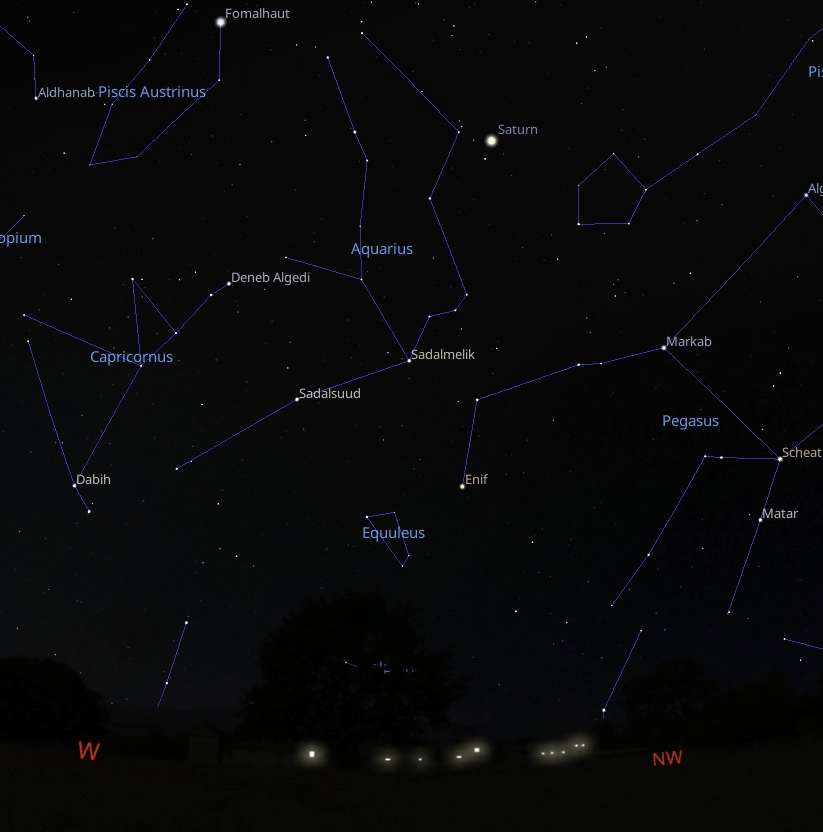
For early “evening viewers” (I always think of Benny Hill when I use this term), say after 6.15pm, beach goers or those on the Darling Scarp would be able to catch a brief glimpse of Venus 5 deg. very low to the WNW horizon after which by 6.30pm, the closest planet to the Sun, Mercury, will sit 10 deg. above the WNW.


Happy brisk viewing with a local take-away and with the kids or grandkids
Dr Craig Bowers MP8138.
All night sky screenshots are courtesy of Stellarium planetarium
Zotti, G., Hoffmann, S. M., Wolf, A., Chéreau, F., & Chéreau, G. (2021). The Simulated Sky: Stellarium for Cultural Astronomy Research. Journal of Skyscape Archaeology, 6(2), 221–258. https://doi.org/10.1558/jsa.17822
 Astronomy West
Leave a comment