
After receiving a great mobile phone photo of Mercury from an avid reader (Lance – It calls it my little blue article), I challenge others to try this, especially on Tuesday just after sunset (say 6.15pm and after) when our two most inner planets, Venus and Mercury are visited by the slender crescent Moon; look 10 deg above the WNW vista.

Tip: On many smartphones there is a professional, night mode, timelapse or low light setting, just find out and don’t forget to keep the phone steady, as the shot may last for a second or two, a tripod is best in accomplishing this and most photographic stores will stock them.
If you stay wherever you are until 8pm, then look to the SW to SSW horizon and allow your gaze to go slowly upwards to almost overhead and down to the NE, but not recommended if you have been drinking.
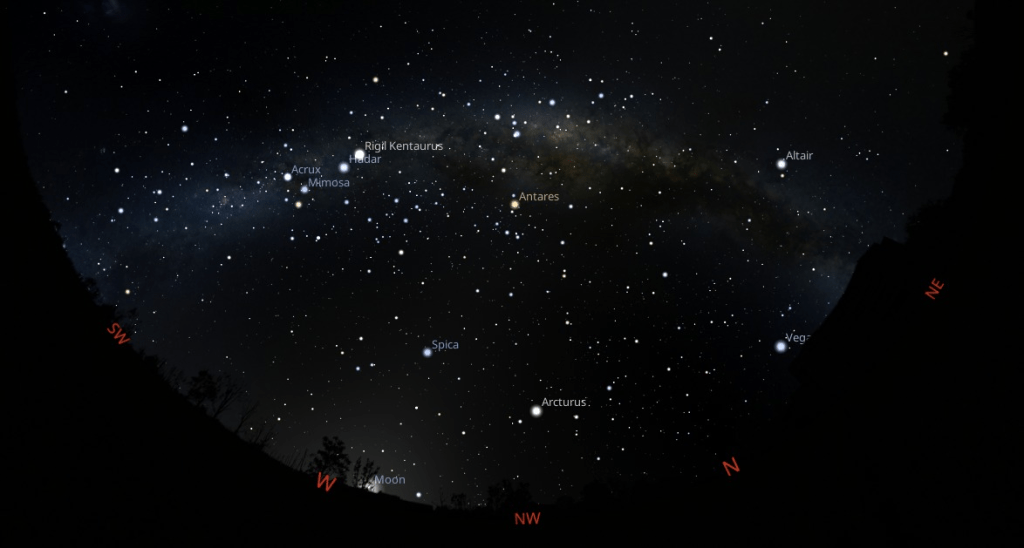
Now, just take a moment to recognise that for FREE, you have just viewed across a spiral arm galaxy that we call the Milky Way.
Why not continue the photographic journey and see if you can get a panorama shot of this galactic wonder; try in a dark location away from City lights, even moving from there to the suburbs sometimes will produce a better of opportunity; if you are in the suburbs, move to the outer suburbs….and so on.
Armed with your trusty tripod, use a timer delay if your phone has one as this will stop any vibration from pushing the button and look for an exposure of around 30 seconds, but check other options like shutter speed.
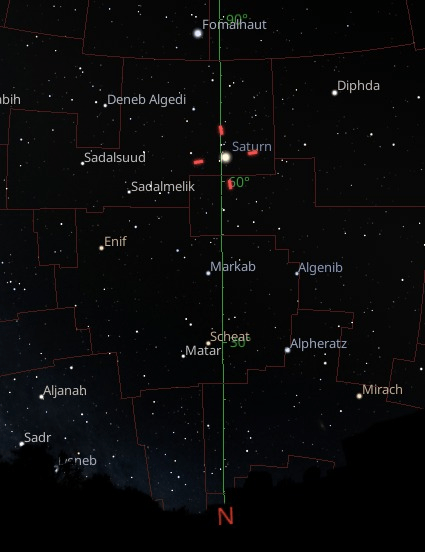
Moving the past midnight, the planet Saturn will sit 65 deg. above due north by 2.30am.
An hour later Mars pops over the ENE horizon with Jupiter just below as they move towards an apparent visual close encounter next week.
Jupiter is high enough by 5.30am to drag the kids out of bed early to view its 4 bright moons in tripod mounted binoculars.

Dr Craig Bowers MP8138.
All night sky screenshots are courtesy of Stellarium planetarium
Zotti, G., Hoffmann, S. M., Wolf, A., Chéreau, F., & Chéreau, G. (2021). The Simulated Sky: Stellarium for Cultural Astronomy Research. Journal of Skyscape Archaeology, 6(2), 221–258. https://doi.org/10.1558/jsa.17822
 Astronomy West
Leave a comment