
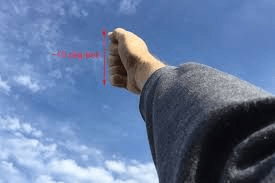
Just a reminder on how to measure 10 degrees in the night sky.
A clenched upright fist held at arm’s length is 10 degrees, with a little imagination and a steady hand, stack them atop each other for multiples of 10 degrees; it doesn’t work if you have been drinking.
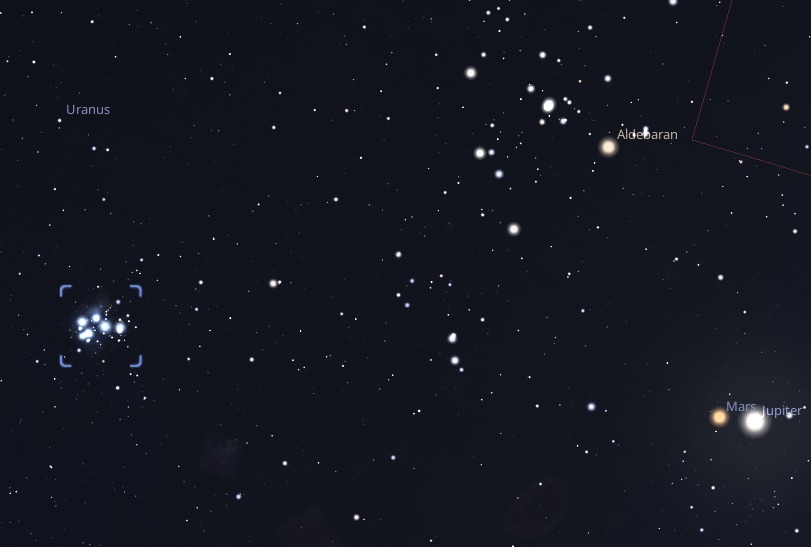
Starting this week’s viewing tomorrow morning, say an hour before sunrise by looking in the NE to NNE direction, it is hard to miss the bedazzling Jupiter sitting 30 deg. up.
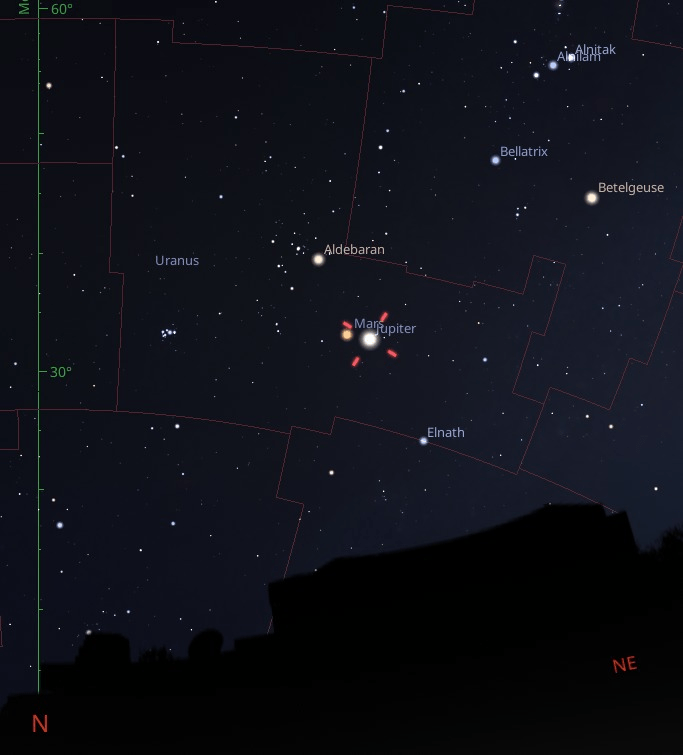
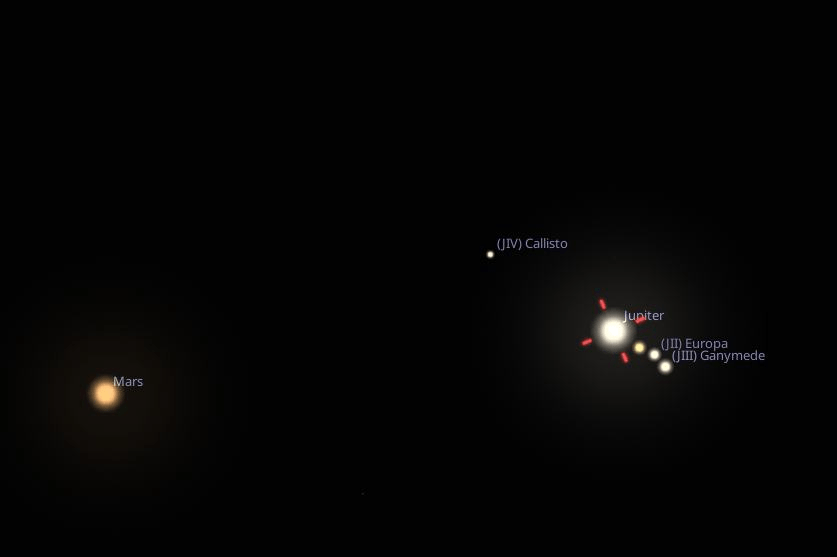
From there, the ruddy red planet Mars is a mere 2 deg. West; by Thursday the pair will be less than 0.5 deg. apart ‘visually’ or ‘as seen from Earth’; it might also be a good time to view Jupiter’s 4 brightest moons in binoculars.
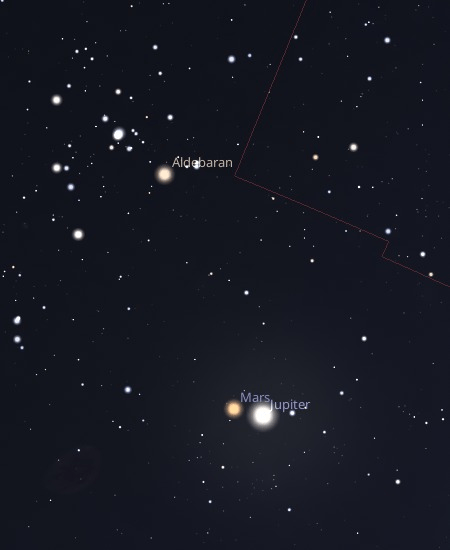
Now, while you are there, just take some time to look up 10 deg. and slightly westwards to find a bright red star, almost like Mars, you have found the star Aldebaran. The star sits at the right foot of a large letter ‘A’ defining the head of an upside-down Bull, or Taurus if you’re into horoscopes.
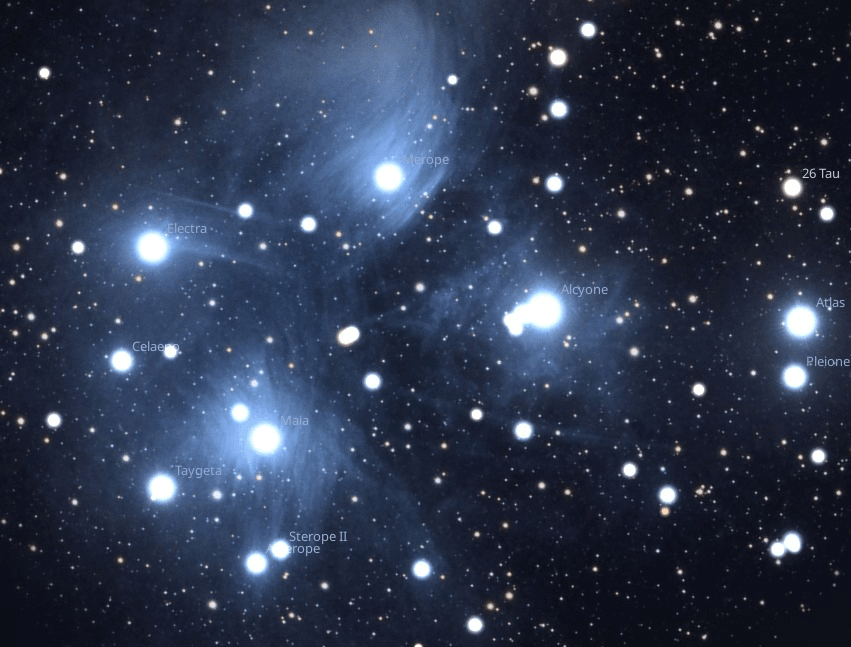
Now, look 10 deg. and downwards the NNW horizon to locate a group of supposedly 7 stars in the shape of a kite, although only 6 are visible to the naked eye, this is the Pleiades or the ‘7 Sisters’……. I only have 2. Once found, pull out the binoculars for a better view of the grouping and possibly view more of the, up to 1000 stars believed to exist in this cluster.
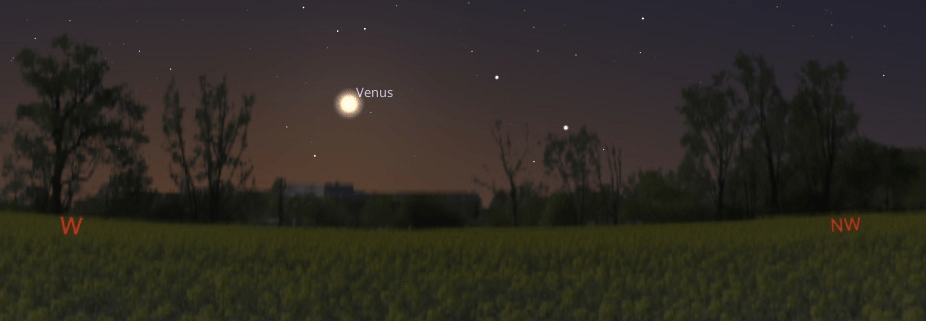
Now if you happen to be by the beach just after sunset, the brilliance of the Venusian light can be found 10 deg. above the WNW horizon.
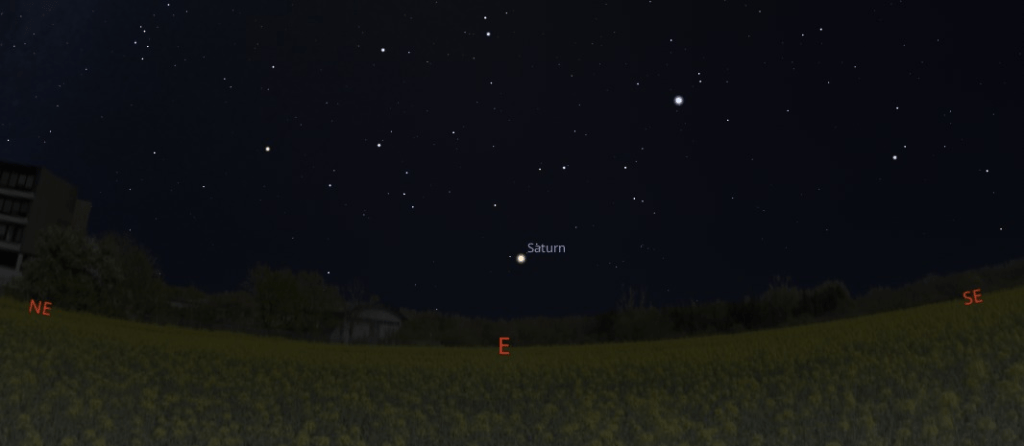
By 8.30pm, if one looks due east, the planet Saturn and be found sitting 10 deg. above the horizon, and by 2.30am due north and 60 deg. up.
As they say in Asimov’s Robots of Dawn that I’m audio booking at the moment on the way to work, “Done viewing”
Dr Craig Bowers MP8138.
All night sky screenshots are courtesy of Stellarium planetarium
Zotti, G., Hoffmann, S. M., Wolf, A., Chéreau, F., & Chéreau, G. (2021). The Simulated Sky: Stellarium for Cultural Astronomy Research. Journal of Skyscape Archaeology, 6(2), 221–258. https://doi.org/10.1558/jsa.17822
 Astronomy West
Leave a comment