By 6:15pm the majestic red glow from our star, the Sun, will harbor the piercing blue-white light from the 2nd inner planet Venus. Unmistakable, it sits 15 deg. above the WNW vista; humans first landed, sort of, in 1970 courtesy of the Cold War and the space race.

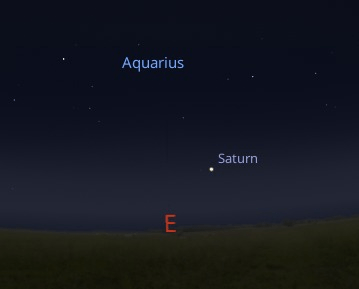
By 8pm, flip ones mince pies to the East to find the original ringed planet Saturn rising and, if you remain till 1:30am, which I realise is a big ask, but stargazing often demands this, will be due North and 65 deg. up.
By 2:30am, the easily familiar constellation of Orion is just rising in the East identifying an approaching season change.

Another hour brings the brilliant Jupiter to rise midway between the NE and ENE and then, best with binoculars, Mars just beneath. The next two hours will see Jupiter and Mars get higher.
While the Moon is full on Tuesday and washes out the sky, it’s still a great object to view. From the same post sunset time of 6.15pm, for the rest of the weekend, use binoculars and sunglasses to view the Moon in the east until it sets. The sunnies take away the glare and allow the almost black and white contrast of the oceans (Maria) and the highlands which make up 80% of the surface to be viewed. This leaves the craters of which there are just under 10,000 recognised out of the 100,000 estimated. Start counting 

A recent paper has suggested a ‘Night Sky Connectedness Index’, something I’ve always felt. https://www.abc.net.au/…/stargazing-and…/104177006
Dr Craig Bowers MP8138.
All night sky screenshots are courtesy of Stellarium planetarium
Zotti, G., Hoffmann, S. M., Wolf, A., Chéreau, F., & Chéreau, G. (2021). The Simulated Sky: Stellarium for Cultural Astronomy Research. Journal of Skyscape Archaeology, 6(2), 221–258. https://doi.org/10.1558/jsa.17822
 Astronomy West
Leave a comment