
Another month closes out.
A Month is defined as an interval of time that is linked to the Moon’s motion around the Earth; the word Moon and Month are cognates, yes, one may have to look it up unless you are a teacher  Yeah teachers.
This week, the Moon starts rising in the ENE by midnight. and by week’s end, not until 5am. It’s always a great object to just look at whether with the naked eye, or through binoculars, just remember for the most, we always see the same face of the Man in the Moon of my childhood.
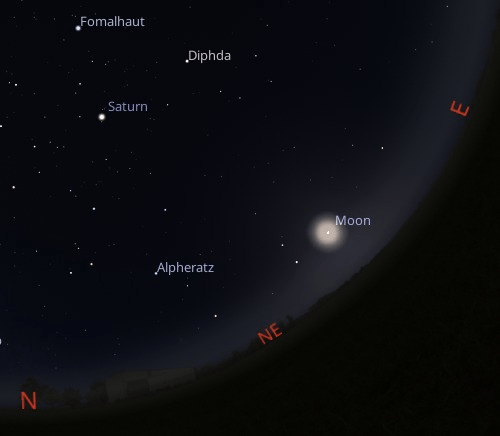
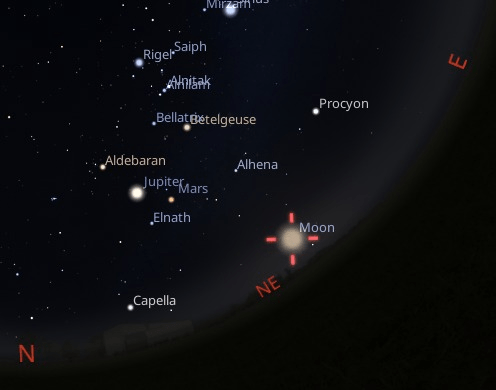
As one either heads to, or arrives at work, the skies east of due north present a veritable feast of naked eye or binocular objects around 5am.
Easily spotted 30 deg. above the NNE is the brilliant Jupiter with the red Mars, 5 deg. eastwards and appearing to move away from it as the week progresses.
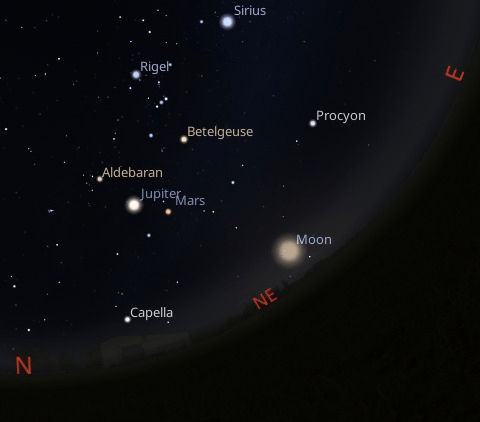
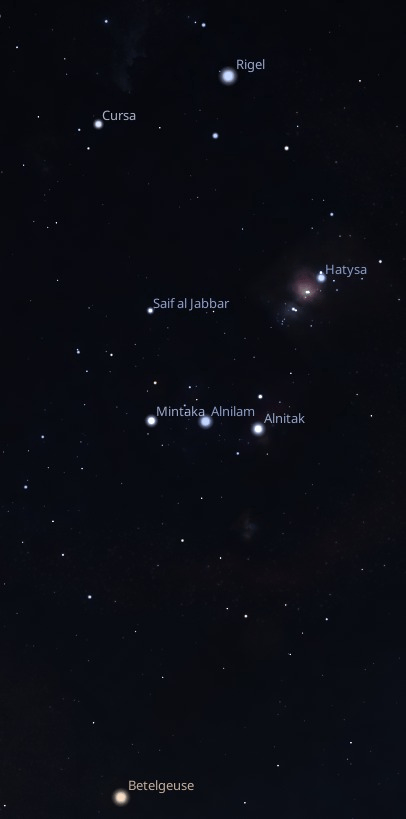
From Mars, lift one’s eyes up 25 deg. to find the middle of the constellation of Orion and its ‘saucepan’ appearance. Use the 3 belt stars, that make the bottom of the saucepan, to direct you the ESE 25 deg. to find the brightest star in the night sky, Sirius, the name derived from the Latin word “Seirios”, or “Lit”.
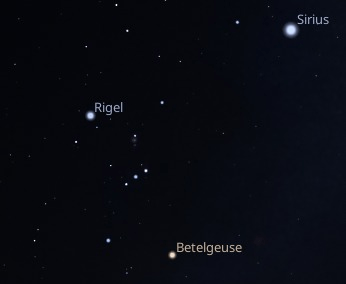
While there, and before sunrise, flip your gaze to 30 deg. above the West to find Saturn before it sets.
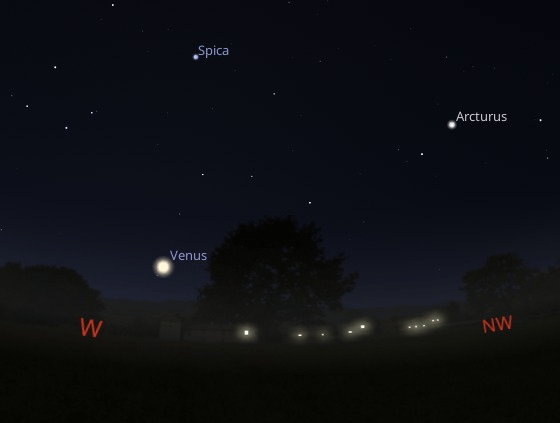
Now for evening viewers. Be at the beach, the scarp or a goldfields clear horizon position by 7pm.
Look to the West to find Venus, look to the East to find Saturn, again, and truly epitomising its moniker as a ‘Wanderer’; in olden times, skywatchers were confused why some objects moved at different rates to the majority of the stars.

Dr Craig Bowers MP8138.
All night sky screenshots are courtesy of Stellarium planetarium
Zotti, G., Hoffmann, S. M., Wolf, A., Chéreau, F., & Chéreau, G. (2021). The Simulated Sky: Stellarium for Cultural Astronomy Research. Journal of Skyscape Archaeology, 6(2), 221–258. https://doi.org/10.1558/jsa.17822
 Astronomy West
Leave a comment